
Unlock The Keyboard:
A Practical System for Keyboard Percussion Fluency
Fix knowing the notes but still missing them,
using keyboard mapping and shift planning.
New here? Start with the free Lite Edition and try it in C.
If it already feels helpful but limited, the full course makes that clarity portable across all 12 keys.
Choose the Format That Fits How You Learn
Unlock the Keyboard is available in two formats.
Some players prefer a concise written guide they can reference during practice.
Others benefit from a fully guided video course with demonstrations and structured progression.
Both formats teach the same underlying framework. They differ only in depth, format, and time commitment.
Two Ways to Use Unlock the Keyboard


Unlock The Keyboard - Full Course
149
A structured course for keyboard percussion fluency. Learn reliable mapping, shift planning, intervals, scales, and harmony through three core systems practiced across all 12 keys.
Valid until canceled
Unlock the Keyboard eBook
-
Written, text-based guide
-
Explains the full framework and core systems
-
Designed as a reference you can return to during practice
-
No videos or play-along tracks
-
Best for players who want clarity without a large time commitment
Most players start here and only move further if they feel they need more structure.
Unlock the Keyboard Course
-
Fully guided video instruction
-
Covers the same framework and core systems in depth
-
Includes demonstrations and play-along tracks for guided application
-
Organized as a structured progression inside the course platform
-
Best for players who want ongoing guidance and a more directed learning path.
Some players choose this format when they know they benefit from structured guidance rather than written reference alone.
Most Percussionists Struggle With Mallets...
Here's Why.
Snare parts feel manageable. Triangle feels straightforward.
But when a keyboard part shows up, things change.
• The notes look overwhelming
• Reading feels slower
• Even when the notes are right, the playing does not feel confident
This is not a talent issue.
Most percussionists were never given a clear framework for how keyboard parts are built, how chords relate, or how patterns behave across the instrument. Without that framework, every new piece feels like starting over.
That gap is what Unlock the Keyboard is designed to address.
Instead of working through dozens of unrelated exercises, the course focuses on a small set of high-value patterns that show up again and again in real mallet parts.
These are the ideas that return the most benefit when you learn them well.
You practice the same core material across different keys and contexts, so patterns begin to feel familiar rather than intimidating.
The result is clearer reading, more confident execution, and a stronger sense of where the music sits on the keyboard.
When a mallet part lands on your stand, you recognize how it works and you know how to approach it.

Where Should You Start?
Most players arrive here in one of two places. Both are valid.
If you just signed up for the Lite Edition:
Use it to feel how patterns map across the keyboard in a single key.
Focus on accuracy and ease rather than speed.
The Lite Edition is intentionally limited so you can test the approach without overload.
If the Lite material already feels helpful but incomplete:
That’s the signal this course is built for.
Unlock the Keyboard extends the same patterns across all 12 keys and introduces the full systems that make accuracy stable in real repertoire.
Many players continue with the written guide and use it as a long-term reference. Others choose the course if they want guided application and structure.
What Changes When the Framework Is in Place
Before working with this material, many percussionists feel unsure where notes sit on the keyboard and second-guess their choices in real time.
As the Unlock the Keyboard framework becomes familiar, players commonly report:
-
Faster recognition of patterns and shapes
-
Less hesitation when reading mallet parts
-
A clearer sense of how harmony and intervals behave
-
More consistent tone and execution
-
Greater confidence when new music appears
These changes come from understanding how keyboard parts are structured and learning to recognize those structures reliably.
Some players reach this point using the written guide as a reference over time. Others prefer to work through the same material in a guided course format with demonstrations and structured progression.
The goal is not perfection. The goal is stability and understanding that carries from one piece to the next.
You’re Not Stuck. You’re Missing a Clear Framework.
Clear structure across all 12 keys
Everything is organized so you always know where you are on the keyboard. The course removes guesswork by showing how patterns behave consistently in every key.
Music theory that actually helps you play
Theory is introduced only where it supports execution and understanding. You learn what matters on the keyboard without being overwhelmed by abstraction.
Learn by systems, not memorization
Instead of isolated drills, you learn repeatable systems that reinforce each other. This makes progress feel stable and transferable, not fragile.
Practice that feels purposeful
Each system includes guidance on how to practice and when to revisit material. You spend less time deciding what to work on and more time improving.
Technique that supports accuracy
Physical setup and motion are addressed directly so accuracy becomes predictable. You learn how to move efficiently rather than forcing results.
Designed for real percussionists
This course reflects how mallet parts actually appear in ensemble music. The material is tested with students and built to transfer directly to real repertoire.

What's Included?
Unlock the Keyboard Framework
(Available in Both Formats)
Unlock the Keyboard is built around a single, cohesive framework made up of several core systems.
That framework is available in two formats: a written guide and a guided course.
The Complete UTK eBook
A written guide that explains the full Unlock the Keyboard framework for reference and reinforcement. All core concepts are presented in text so you can revisit them during practice as needed.
Pathfinder Scale System
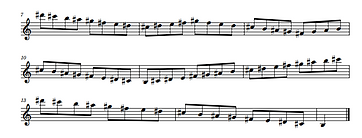
A structured approach to scale fluency that builds orientation and confidence across all 12 keys. Includes extended Green Scales written out clearly so you always know what to practice.
Interval Matrix System
A chromatic interval training system that develops awareness of distance, shape, and manual relationships. Designed to improve reading accuracy and reduce hesitation.
Chroma Code Harmonic System
A complete chord fluency system based on triads and seventh chords. Includes the signature progression explained step by step so harmonic patterns feel familiar in real music.
These systems form the core of Unlock the Keyboard and are fully explained in the written guide and more deeply in the course.
Demonstrations and Play Along Tracks*
Available in the course only, each system is demonstrated clearly, with play-along tracks provided in multiple tempos.
These are designed to support consistent, focused practice rather than rushed progression.
All course materials are consolidated into one place so players who prefer guided instruction do not need to guess what comes next.
How to Use Unlock the Keyboard in Your Practice
Unlock the Keyboard is designed to fit into a real practice routine, not replace it.
Most players use the material as a focused warm-up or as a short, dedicated block at the beginning of a practice session. Even 10 to 20 minutes at a time is enough when the material is revisited consistently.
The goal is not to rush through the course. The systems are meant to be returned to over time as your reading, repertoire, and technical demands grow.
Many students keep specific exercises in rotation long after completing the course.
This works best when you prioritize clarity over speed and let familiarity develop naturally.
What This Is Not
Unlock the Keyboard is not a shortcut, and it is not a replacement for practice.
It does not promise instant results without effort or attention.
The framework is designed for players who want a clearer way to understand keyboard parts and are willing to engage with the material thoughtfully and consistently, whether they are using the written guide or the guided course format.
The goal is steady, reliable improvement through clarity and familiarity, not quick fixes or surface-level progress.
Course Access and Format
Unlock the Keyboard is a fully recorded online course hosted on MyPercussionPath.
This section applies to the guided course format only.
• Stream all videos directly inside the course platform
• Access the material anytime after enrollment
• Includes the UTK eBook, demonstrations, and play-along tracks
• Progress at your own pace
There are no downloads required to begin, and nothing expires.
See How The Course is Structured
This is the full introduction lesson where the three core systems are explained and how they work together.
If you want to understand how Unlock the Keyboard works before enrolling, this lesson shows the approach in full.

Who Is This For?
• High school and college percussionists who want clearer, more reliable keyboard skills
• Adult learners returning to mallet percussion after time away
• Community band percussionists who want to feel confident on keyboard parts
• Band directors looking for a structured resource students can use independently
• Anyone tired of guessing what to practice and ready for a clearer system
Whether you are working toward better sight reading, smoother execution, or simply more confidence at the keyboard, this course provides a clear foundation you can rely on.

About the Creator
Created by Spencer Perilloux
Spencer Perilloux is a professional percussionist and educator specializing in versatile percussion fluency and practical musicianship.
He holds degrees from the University of Michigan and Central Michigan University and has taught students across a wide range of ages and experience levels.
Spencer’s teaching focuses on clarity, efficiency, and understanding why things work. His approach emphasizes physical reliability, visual mapping, and system-based practice so players can move beyond memorization and play with confidence.
Unlock the Keyboard was created to address common gaps in traditional percussion education and to give players a clear framework they can rely on in real musical situations.


